Showing posts with label 1940's. Show all posts

Monday, February 6, 2012

Manly Monday

Two one syllable words: So hot!

Officer in Blue, Harlem, 1943
Photographer Gordon Parks for the Office of War Information (OWI).
Mr. Police Officer in Harlem, 1943

Friday, January 20, 2012

Join the Flight!

The movie "Red Tails" takes flight today! It is the gripping true story of the Tuskegee Airmen in the midst of  World War II. Red Tails has an all African-American cast starring: Terrence Howard, Cuba Gooding, Jr., Bryan Cranston, Nate Parker, and David Oyelowo. Critics in Hollywood were saying that no one wants to see an all black cast in a movie. Executive producer, George Lucas, believed in this movie so much that he had to put his own money ($100 million) into the making of this film to see that the project finally got finished! If you don't want to support this movie for any of the above reasons, then at least see it because it is an epic action movie, not just a "black movie".


Monday, November 7, 2011

Screams For Eames

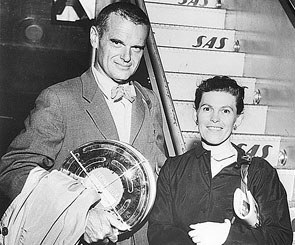
Charles (1907-1978) and Ray Eames (1912-1988).
Who doesn't know that Eames products are quintessential for creating your mid-century style home or Mad Men office? But did you know Charles Ormond Eames Junior is a native of St. Louis, MO?  He attended Washington University's School of Architecture. It is rumored he was dismissed from the school because of his modern views. Others say it was because of sleep deprivation between having the demands of school and work. To further his education in architecture, he moved (in 1938) to Michigan. Charles attended the Cranbrook Academy of Art. He decided to use the St. Louis riverfront as his area of focus in order to apply for the Architecture and Urban Planning Program. With the help of Eero Saarinen (friend architect partner), Charles designed prize-winning furniture for New York's Museum of Modern Art "Organic Design in Home Furnishings" competition. Originally developed by Alvar Aalto, it displayed the newer technique of wood moulding. Eames further developed this technique in multiple moulded plywood products including: splints and stretchers for the U.S. Navy during World War II, and of course furniture!

After Charles divorced his wife of 12 years and mother of his daughter, named Lucia, Charles Eames married his second wife in 1941. He married his Cranbrook colleague Ray Kaiser. Mrs. Bernice Alexandra "Ray" Eames met Charles while preparing models and drawings for the "Organic Design in Home Furnishings" competition in September of 1940. Tsk Tsk.. dating before you're even officially divorced.

In 1943, 1944, and 1947, Ray Eames designed several covers for the reputable magazine, Arts & Architecture. She also had two of several textile designs produced by the company Schiffer Prints. So yeah, Ray can stand on her own two feet. Though, it is agreeable that Mrs. Ray was very involved and important in the designs with her husband. The Eames fabrics were mostly designed by her.

The Eames continued to be innovative in the 1950's, using plastic resin chairs and the wire mesh chairs designed for Herman Miller.

Throughout the mid to late 50's and into the 60's and 70's, Charles designed many exhibitions:
  • Textiles and Ornamental Arts of India (1955)
  • Glimpses of the USA (seven screens for the American exhibition in Moscow, Sokoolniki Park) (1959)
  • Mathematica (for IBM, 1961)
  • IBM Pavilion at the 1964 New York World's Fair
  • Nehru: The man and his India (1965)
  • The World of Franklin and Jefferson (1975) built for the US Bicentennial Commission opens in Paris, travels to five other countries and the US.
The couple had many short films documenting their interest, what we would consider indie films today. As part of the 20th Annual St. Louis Int'l Film Festival, the Sam Fox School of Design and Visual Arts' Steinberg Auditorium at Washington University, will be screening "Eames: The Architect & the Painter". It is a revealing documentary on the husband-and-wife team.

Eames films include:

  • Traveling Boy (1950)
  • Blacktop: A Story of the Washing of a School Play Yard (1952)
  • Parade Parade Or Here They Are Coming Down Our Street (1952)
  • A Communications Primer (1953)
  • House: After Five Years of Living (1955)
  • Day of the Dead (1957)
  • Toccata for Toy Trains (1957)
  • Kaleidoscope Jazz Chair (1960)
  • Powers of Ten (1968, rereleased in 1977)
  • Image of the City (1969)
  • Banana Leaf (1972)
  • Fiberglass Chairs
  • SX-70
  • Eames Lounge Chair

No doubt they are part of America's most influential and important industrial designers!
Sunday, September 18, 2011

Not So Secret Admirers | 1944


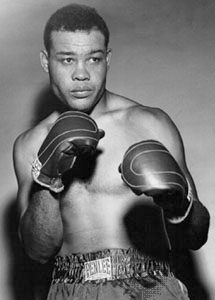
The Lady getting all of the attention is big band singer Marva Louis. Boxing champion Joe Louis was her husband, twice! The men in the photo are some of 2,000 recruits at the U.S. Naval Training Station, Great Lakes, Illinois. They all were entertained by her singing in a drill hall. It's sad that African Americans fought for America only to come back home as second class citizens still.

The one thing I've noticed in most of these "popular" blogs from vintage admirers is the lack of acknowledgement for African Americans or people of color in general. It's like people of color didn't even exist. The past for African Americans isn't all milk and honey, but it certainly can't be ignored. I refuse to not learn more about my roots, which is really EVERYONE history. To just skip over any historical events or not include any images reflecting people of color, whether it's on these retro blogs or generally and genuinely in your life for whatever reasons is just.. plain ignorant. We can't change the past or sugar-coat actual events, but we can change our future and we (African Americans) sure are still doing it! I am deeply humbled and have respect for the people who came before me. They went through way more than I ever had to go through in my whole lifetime! Now because of them, I have this lifestyle in today's world. So with pride, not shame, I can truly say I am an not so secret admirer of my ancestors.


Marva Louis (1915-2000) accompanied by sailors.

Champion boxer Joe Louis (1914-1981)


Saturday, September 17, 2011

Christina Aguilera - Candyman

The fashion in this Christina Aguilera video is that of a young 1940's USO woman!


Rationing of fabrics made women focus on their looks even more. The goal: to still look and feel gloriously feminine and beautiful. The good news is that we all can recreate this style today!


Besame Cosmetics is a must-have for achieving your 1940's look, especially, for in the boudoir! I first discovered this company from a very helpful website. They have the best victory red lipstick, which is a true classic red. It comes in a velvet cover-slip!  There are more brands out there cheaper and readily available at any local drugstore, of course, it won't come in fancy vintage packaging.


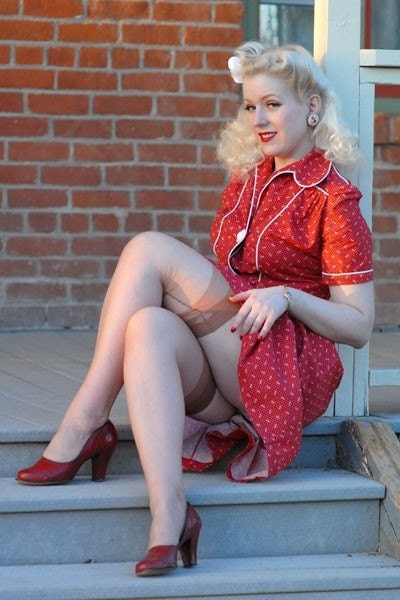
Model: Bernie Dexter
This is in her actual boudoir!

Eyebrows were shaped natural, but stray hairs were tweezed to have clean arches. Like in today's fashion world, false lashes and mascara were used. Eyeshadow was more of nude and grey hues. Nails were worn short to mid-length.


Actress, singer, dancer, Betty Grable,
the famous pin-up girl of the 1940's.

Hair, very important. The 1940's hairstyles are ultra glamorous and more importantly timeless!


Women sporting their "Victory Rolls" at the beach.


One of the carefully crafted hairstyles of the forties is the "Victory Roll" aka the "Side Reverse Roll", named after a combat air maneuver. To set hair women used either rollers or pinned curls at night, and then slept on them to produce curls in the morning. When the rollers or pins came out, hair was given a minimum of brushing, not to remove the curls but make them softer towards the ends. Hair near the crown was sectioned on each side and pinned up, off the face.

How-to Video:


Back seam hosiery was more likely to be in rayon fabric, since real silk went toward use in parachutes for troops.


Etsy Shop Sissales

There are different types of dresses, as well as hats, for different occasions in this era.


Popular shoes were wedges and round toe pumps.


Etsy Shop vintagediva60

Together we can encompass the classy romance of yesteryear!

Thursday, September 15, 2011

Air Hero: "Butch" O'Hare

This handsome fellow is Edward "Butch" O'Hare.
(March 13, 1914 - November 26, 1943)


Born in St. Louis, Missouri,  "Butch" O'Hare is quite the naval aviator hometown hero. If the United States "badly needed a hero in 1942", then we surely got another one! On February 20, 1942, LT O'Hare was one of two Navy fighters available in air when Japanese bombers, "Betty's", were attacking his aircraft carrier USS Lexington. His wingman "Duff" Dufilho's guns got jammed and wouldn't fire. So, "Butch" O'Hare was the only protection for the carrier Lexington. With eight "Betty's" in a "V" formation he single-handedly shot down five and left a sixth damaged. He only had enough ammunition to last for 34 seconds of firing! Lieutenant Commander Thach arrived at the scene with other pilots of the flight, later reporting that at one point he saw three of the enemy bombers falling in flames at the same time. A "Betty" tried to hit Lexington with his damaged plane. He missed and flew into the water near the Lexington. The other two planes were also damaged by O'Hare and landed safely, but the escapees were shot by LT Noel Gayler 40 miles from Lexington.

The actions of "Butch" O'Hare earned him the spotlight of the media greeting him at Pearl Harbor on March 26, 1942. He then held a press conference at the Royal Hawaiian Hotel. On a radio show in Honolulu he gave a shout-out to his wife Rita saying, "Here's a great big radio hug, the best I can do under the circumstances". The first time O'Hare met nurse Rita (on July 22, 1941) he proposed to her! He sent another shout-out to his mother Selma, simply saying a heartfelt, "Love from me to you".

O'Hare was decorated with medals, one being the Medal of Honor. It was placed around his neck by his wife (they are so sweet together)! He also had a welcome home parade. A newspaper headline read, "60,000 give O'Hare a hero's welcome here". Yet, he hardly liked any lavishly huge recognitions and didn't like talking about himself as a hero. For him, he is part of a team of heroic brothers. When he passed away in November of 1943, after leading the first U.S. Navy nighttime fighter attack, his mother Selma O'Hare didn't really allow any monuments in honor of her son in the city of St. Louis. There is, however, an international airport in Chicago, Illinois, that was named after him on September 19, 1949. Former President John F. Kennedy did a wreath-laying ceremony at O'Hare Airport in March of 1963. Widowed wife Rita and daughter Kathleen did receive his posthumous decorations, the Navy Cross and a Purple Heart on November 26, 1944.


Tuesday, September 13, 2011

Working Women in WWII

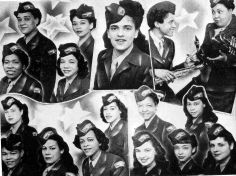
African American military women.

Interesting that not only positions such as nurses, pilots, spies, and marines were being filled, but to the everyday women of the 1940's these mostly male positions were open:
  • architect
  • astronomer
  • blacksmith
  • bus driver
  • butcher
  • chemist
  • clerical workers
  • coat check
  • consultant
  • doorman
  • draftsman
  • electrician
  • elevator operator
  • engineer
  • factory packer and shipper
  • farmer
  • ferry pilot
  • fireman
  • forest fire fighter
  • furnace operator (in a steel mill)
  • garbage collector
  • geologist
  • journalists
  • laborer
  • laywer
  • logger
  • mathematician
  • mechanic
  • meteorologist
  • milkman
  • musician
  • ordnance worker
  • physicist
  • police officer
  • postman
  • professional baseball player
  • riveter
  • shipyard worker
  • statistician
  • street cleaner
  • supervisor
  • surveyor
  • switch board operator
  • taxi driver
  • telepgraph operator
  • ticket taker
  • tinsmith
  • traffic cop
  • trolley car operator
  • welder

These jobs involved some level of education and skills. Just goes to show that these women weren't dumb housewives. They were women who wanted to have a family more than a career after their schooling. Makes me think of the movie Mona Lisa Smile (set in the 1950's).