1960's heartthrob Davy Jones.
Photo: Michael Ochs Archives/Getty Image
For those Monkees fans out there:
I used to watch the Brady Bunch re-runs. I was watching them at like nine years old on Nickelodeon. LOL and I also used to be infatuated with NSYNC as a teen, so I totally understand the boy band craze!
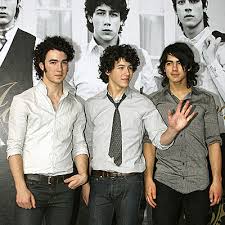
I think a modern day version of The Monkees would be The Jonas Brothers.
By the way, the Jonas Brothers
are always so well-dressed.
Happy birthday to Alicia Keys! This music video reminds me of The Loving Story. I think it is very fitting that Alicia Keys being biracial in real life, played the role of a young African-American lady in love. She can't be with her love (played by Chad Michael Murray) because he is a Caucasian man and that was just so unthinkable to others back then. The video progresses in time, yet, features the same issue through different time periods to present day. I'm sure close-minded people are still giving interracial couples problems today. Why do other people always feel like it is their job to stick their noses where it doesn't belong?
“For the first time, I could put my arm around Mildred and publicly call her my wife.” - Richard Loving, in 1967 after the Supreme Court unanimously decided in their favor.
This is Mildred Loving and Richard Perry Loving.
They are Virginia's first interracial legal marriage!
In June 1958, the couple got married in Washington, D.C. (where interracial marriage was legal). However, they were arrested upon they're return home in Virginia and sentenced to one year in jail for violating the state's Racial Integrity Act.
Richard and Mildred Loving with their children
Peggy, Donald, and Sidney in their living room.
King and Queen County, Virginia, April 1965.
LIFE magazine photographer Grey Villet traveled to Virginia to cover the "Loving vs. Virginia" legal battle. His photos showed an intimate and humane look at the couple and of their family daily life.
Peggy, Sidney, and Donald Loving playing.
King and Queen County, Virginia, April 1965.
In June 1967, the court unanimously declared Virginia's Racial Integrity Act of 1924 unconstitutional and ended all race-based marriage bans in the U.S.
Villet's photos were uncovered by director Nancy Buirski during the filming of her upcoming documentary, “The Loving Story,” debuting on February 14 on HBO. The photos can also be viewed at the International Center of Photography in New York City from January 20 through May 6, 2012. CLICK HERE to read the Lovings' full story and see additional photos!
Etta James passed away today at the age of 73! She struggled with leukemia, dementia and kidney problems. :-(
Etta James musical career spanned six decades. She started out in a group called, "The Peaches" singing background vocals. Then she went solo ending up with a second Top 10 hit in 1955 with "Good Rockin' Daddy." After beginning to date The Moonglows vocalist, Harvey Fuqua, James signed with Chess Records'. Producer, Leonard Chess, believed James had crossover pop potential, and backed her material with orchestral arrangements. With this new style, many of James songs became hits on both the R&B and Pop charts, such as "All I Could Do Was Cry", "At Last", and "Trust in Me." She released her debut album, At Last! in 1960, followed by The Second Time Around in 1961. In 1968, James had her first Top 10 hit in three years with "Tell Mama", which was followed by an album of the same name. Her discography consists of 28 studio albums, 3 live albums, and 6 compilations. She has a total of 58 singles!
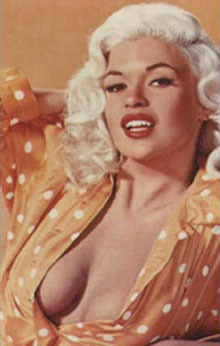
Before Anna Nicole Smith, there was Jayne Mansfield; American actress and sexual icon of the 1950s and 1960s!
Left: Anna Nicole Smith.
(November 28, 1967 – February 8, 2007)
Right: Jayne Mansfield.
(April 19, 1933 – June 29, 1967)
"If you're going to do something wrong, do it big, because the punishment is the same either way."
Fact sheet About Jayne: 1. Born as Vera Jayne Palmer. 2. She wore a blonde wig; naturally a brunette. 3. Height: 5' 6¼". 4. Measurements: 46D-18-36, after having kids! 5. She had four children, Jayne Marie Mansfield, Mickey Jr Hargitay, Zoltan Hargitay, and Mariska Hargitay. 6. One of her daughters, Mariska Hargitay, plays Detective Olivia Benson on "Law & Order: SVU". 7. She had a very high IQ. 8. She attended the University of Texas at Austin, the University of Dallas, UCLA, and Southern Methodist University.
9. She spoke five languages, and was a classically trained pianist and violinist.
Jayne Mansfield at the pink gates
of her house, which had her intials J M.
10. She was obsessed with the color pink. Jayne lived in a house located at 10100 Sunset Boulevard, in Beverly Hills. It was painted pink and became known as the Pink Palace. 11. She had a heart shaped swimming pool. It used to have "I love you Jaynie" in mosaic on the floor of it built by her husband at the time, Mickey Hargitay. 12. She turned down the role of Ginger on Gilligan’s Island.
Jayne Mansfield with Marilyn Monroe.
13. She actually admired Marilyn Monroe, even though, throughout her career she was compared by the media to Monroe and the other top sex symbol Mamie Van Doren.
14. 20th Century Fox signed a six-year contract with Mansfield to replace Marilyn Monroe as their resident blonde sex symbol.
15. Jayne starred in several popular Hollywood films that emphasized her platinum-blonde hair, hourglass figure and cleavage revealing costumes.
16. Jayne notoriously pulled publicity stunts by exposing her cleavage and fully exposing her boobs in "accidents".
17. She was a Playboy Playmate of the Month and appeared in the magazine several additional times.
18. She had a role in the film "Promises! Promises!", which isthe first Hollywood motion picture with sound to feature a mainstream star in the nude.
On Location
She died in a gruesome car-truck accident at the age of 34. Some say she was beheaded upon impact. Others think the impact scalped her, or that it was her wig knocked off by the impact shown in photos after the accident. The car she was in at the time was a 1966 Buick Electra. All three people in the front seat including Jayne died instantly. The three children she had with Hargitay were also in the backseat at the time with four Chihuahuas. Miraculously, the children survived. One dog did die. Jayne's casket was completely covered in pink roses. The Jayne Mansfield accident resulted in the Hollywood Screen Actors Guild and the Louisiana State Police successfully lobbying Congress for the "Block Bar" a.k.a. "the Mansfield Bar", which was legislated in 1967 to be installed on all semi trailers and trucks to prevent cars from running up under the back of them. What a tragic ending.. like most Hollywood tales.
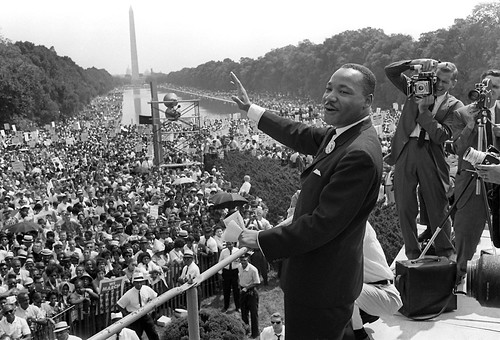
I am happy to join with you today in what will go down in history as the greatest demonstration for freedom in the history of our nation.
Five score years ago, a great American, in whose symbolic shadow we stand today, signed the Emancipation Proclamation. This momentous decree came as a great beacon light of hope to millions of Negro slaves who had been seared in the flames of withering injustice. It came as a joyous daybreak to end the long night of their captivity.
But one hundred years later, the Negro still is not free. One hundred years later, the life of the Negro is still sadly crippled by the manacles of segregation and the chains of discrimination. One hundred years later, the Negro lives on a lonely island of poverty in the midst of a vast ocean of material prosperity. One hundred years later, the Negro is still languishing in the corners of American society and finds himself an exile in his own land. So we have come here today to dramatize a shameful condition.
In a sense we have come to our nation's capital to cash a check. When the architects of our republic wrote the magnificent words of the Constitution and the Declaration of Independence, they were signing a promissory note to which every American was to fall heir. This note was a promise that all men, yes, black men as well as white men, would be guaranteed the unalienable rights of life, liberty, and the pursuit of happiness.
It is obvious today that America has defaulted on this promissory note insofar as her citizens of color are concerned. Instead of honoring this sacred obligation, America has given the Negro people a bad check, a check which has come back marked "insufficient funds." But we refuse to believe that the bank of justice is bankrupt. We refuse to believe that there are insufficient funds in the great vaults of opportunity of this nation. So we have come to cash this check -- a check that will give us upon demand the riches of freedom and the security of justice. We have also come to this hallowed spot to remind America of the fierce urgency of now. This is no time to engage in the luxury of cooling off or to take the tranquilizing drug of gradualism. Now is the time to make real the promises of democracy. Now is the time to rise from the dark and desolate valley of segregation to the sunlit path of racial justice. Now is the time to lift our nation from the quick sands of racial injustice to the solid rock of brotherhood. Now is the time to make justice a reality for all of God's children.
It would be fatal for the nation to overlook the urgency of the moment. This sweltering summer of the Negro's legitimate discontent will not pass until there is an invigorating autumn of freedom and equality. Nineteen sixty-three is not an end, but a beginning. Those who hope that the Negro needed to blow off steam and will now be content will have a rude awakening if the nation returns to business as usual. There will be neither rest nor tranquility in America until the Negro is granted his citizenship rights. The whirlwinds of revolt will continue to shake the foundations of our nation until the bright day of justice emerges.
But there is something that I must say to my people who stand on the warm threshold which leads into the palace of justice. In the process of gaining our rightful place we must not be guilty of wrongful deeds. Let us not seek to satisfy our thirst for freedom by drinking from the cup of bitterness and hatred.
We must forever conduct our struggle on the high plane of dignity and discipline. We must not allow our creative protest to degenerate into physical violence. Again and again we must rise to the majestic heights of meeting physical force with soul force. The marvelous new militancy which has engulfed the Negro community must not lead us to a distrust of all white people, for many of our white brothers, as evidenced by their presence here today, have come to realize that their destiny is tied up with our destiny. They have come to realize that their freedom is inextricably bound to our freedom. We cannot walk alone.
As we walk, we must make the pledge that we shall always march ahead. We cannot turn back. There are those who are asking the devotees of civil rights, "When will you be satisfied?" We can never be satisfied as long as the Negro is the victim of the unspeakable horrors of police brutality. We can never be satisfied, as long as our bodies, heavy with the fatigue of travel, cannot gain lodging in the motels of the highways and the hotels of the cities. We cannot be satisfied as long as the Negro's basic mobility is from a smaller ghetto to a larger one. We can never be satisfied as long as our children are stripped of their selfhood and robbed of their dignity by signs stating "For Whites Only". We cannot be satisfied as long as a Negro in Mississippi cannot vote and a Negro in New York believes he has nothing for which to vote. No, no, we are not satisfied, and we will not be satisfied until justice rolls down like waters and righteousness like a mighty stream.
I am not unmindful that some of you have come here out of great trials and tribulations. Some of you have come fresh from narrow jail cells. Some of you have come from areas where your quest for freedom left you battered by the storms of persecution and staggered by the winds of police brutality. You have been the veterans of creative suffering. Continue to work with the faith that unearned suffering is redemptive.
Go back to Mississippi, go back to Alabama, go back to South Carolina, go back to Georgia, go back to Louisiana, go back to the slums and ghettos of our northern cities, knowing that somehow this situation can and will be changed. Let us not wallow in the valley of despair.
I say to you today, my friends, so even though we face the difficulties of today and tomorrow, I still have a dream. It is a dream deeply rooted in the American dream.
I have a dream that one day this nation will rise up and live out the true meaning of its creed: "We hold these truths to be self-evident: that all men are created equal."
I have a dream that one day on the red hills of Georgia the sons of former slaves and the sons of former slave owners will be able to sit down together at the table of brotherhood.
I have a dream that one day even the state of Mississippi, a state sweltering with the heat of injustice, sweltering with the heat of oppression, will be transformed into an oasis of freedom and justice.
I have a dream that my four little children will one day live in a nation where they will not be judged by the color of their skin but by the content of their character.
I have a dream today.
I have a dream that one day, down in Alabama, with its vicious racists, with its governor having his lips dripping with the words of interposition and nullification; one day right there in Alabama, little black boys and black girls will be able to join hands with little white boys and white girls as sisters and brothers.
I have a dream today.
I have a dream that one day every valley shall be exalted, every hill and mountain shall be made low, the rough places will be made plain, and the crooked places will be made straight, and the glory of the Lord shall be revealed, and all flesh shall see it together.
This is our hope. This is the faith that I go back to the South with. With this faith we will be able to hew out of the mountain of despair a stone of hope. With this faith we will be able to transform the jangling discords of our nation into a beautiful symphony of brotherhood. With this faith we will be able to work together, to pray together, to struggle together, to go to jail together, to stand up for freedom together, knowing that we will be free one day.
This will be the day when all of God's children will be able to sing with a new meaning, "My country, 'tis of thee, sweet land of liberty, of thee I sing. Land where my fathers died, land of the pilgrim's pride, from every mountainside, let freedom ring."
And if America is to be a great nation this must become true. So let freedom ring from the prodigious hilltops of New Hampshire. Let freedom ring from the mighty mountains of New York. Let freedom ring from the heightening Alleghenies of Pennsylvania!
Let freedom ring from the snowcapped Rockies of Colorado!
Let freedom ring from the curvaceous slopes of California!
But not only that; let freedom ring from Stone Mountain of Georgia!
Let freedom ring from Lookout Mountain of Tennessee!
Let freedom ring from every hill and molehill of Mississippi. From every mountainside, let freedom ring.
And when this happens, when we allow freedom to ring, when we let it ring from every village and every hamlet, from every state and every city, we will be able to speed up that day when all of God's children, black men and white men, Jews and Gentiles, Protestants and Catholics, will be able to join hands and sing in the words of the old Negro spiritual, "Free at last! free at last! Thank God Almighty, we are free at last!"
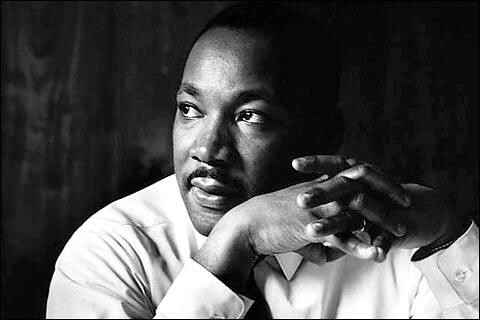
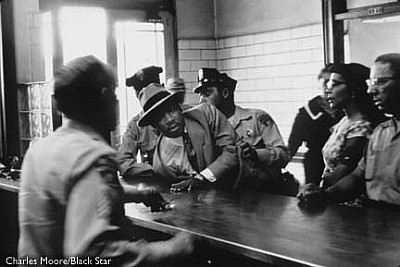
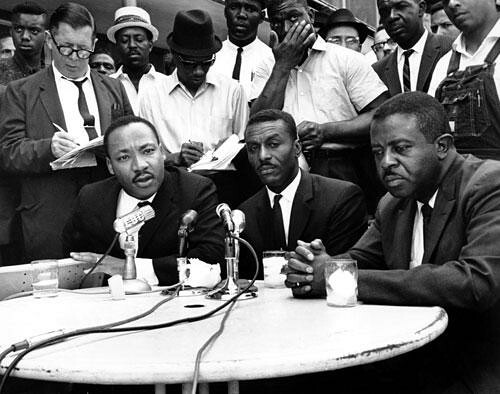
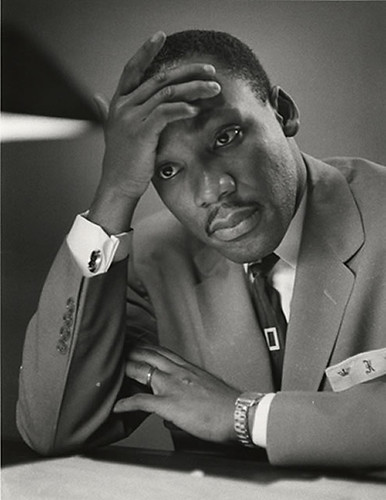
Martin Luther King Jr. A young man with alot on his mind, destined to do great things.
Martin Luther King is sprawled across the police desk
as his wife, Coretta Scott, looks on stunned.
He was arrested for loitering at the Montgomery Courthouse
and released when his identity became known to the police.
Montgomery, AL 1958.
What is he thinking in this moment?
Whatever it is, burden is written all over his face.
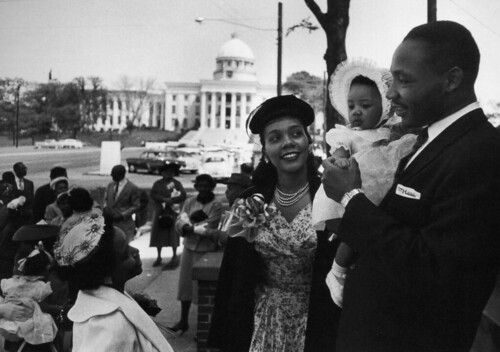
Coretta Scott King, Yolanda Denise King, and family man Martin Luther King, Jr.
stand on the stairs of Dexter Avenue Baptist Church in spring of 1956.
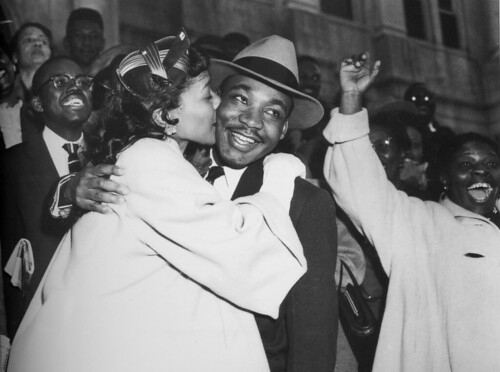
Coretta Scott King embraces Martin Luther King, Jr. on 22 March 1956
after he was found guilty of conspiracy to boycott in Montgomery, Alabama.
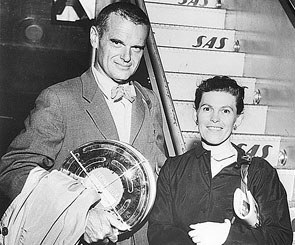
Who doesn't know that Eames products are quintessential for creating your mid-century style home or Mad Men office? But did you know Charles Ormond Eames Junior is a native of St. Louis, MO? He attended Washington University's School of Architecture. It is rumored he was dismissed from the school because of his modern views. Others say it was because of sleep deprivation between having the demands of school and work. To further his education in architecture, he moved (in 1938) to Michigan. Charles attended the Cranbrook Academy of Art. He decided to use the St. Louis riverfront as his area of focus in order to apply for the Architecture and Urban Planning Program. With the help of Eero Saarinen (friend architect partner), Charles designed prize-winning furniture for New York's Museum of Modern Art "Organic Design in Home Furnishings" competition. Originally developed by Alvar Aalto, it displayed the newer technique of wood moulding. Eames further developed this technique in multiple moulded plywood products including: splints and stretchers for the U.S. Navy during World War II, andof course furniture!
After Charles divorced his wife of 12 years and mother of his daughter, named Lucia, Charles Eames married his second wife in 1941. He married his Cranbrook colleague Ray Kaiser. Mrs. Bernice Alexandra"Ray"Eames met Charles while preparing models and drawings for the "Organic Design in Home Furnishings" competition in September of 1940. Tsk Tsk.. dating before you're even officially divorced.
In 1943, 1944, and 1947, Ray Eames designed several covers for the reputable magazine, Arts & Architecture. She also had two of several textile designs produced by the company Schiffer Prints. So yeah, Ray can stand on her own two feet. Though, it is agreeable that Mrs. Ray was very involved and important in the designs with her husband. The Eames fabrics were mostly designed by her.
The Eames continued to be innovative in the 1950's, using plastic resin chairs and the wire mesh chairs designed for Herman Miller.
Throughout the mid to late 50's and into the 60's and 70's, Charles designed many exhibitions:
Textiles and Ornamental Arts of India (1955)
Glimpses of the USA (seven screens for the American exhibition in Moscow, Sokoolniki Park) (1959)
Mathematica (for IBM, 1961)
IBM Pavilion at the 1964 New York World's Fair
Nehru: The man and his India (1965)
The World of Franklin and Jefferson (1975) built for the US Bicentennial Commission opens in Paris, travels to five other countries and the US.
The couple had many short films documenting their interest, what we would consider indie films today. As part of the 20th Annual St. Louis Int'l Film Festival, the Sam Fox School of Design and Visual Arts' Steinberg Auditorium at Washington University, will be screening "Eames: The Architect & the Painter". It is a revealing documentary on the husband-and-wife team.
Eames films include:
Traveling Boy (1950)
Blacktop: A Story of the Washing of a School Play Yard (1952)
Parade Parade Or Here They Are Coming Down Our Street (1952)
A Communications Primer (1953)
House: After Five Years of Living (1955)
Day of the Dead (1957)
Toccata for Toy Trains (1957)
Kaleidoscope Jazz Chair (1960)
Powers of Ten (1968, rereleased in 1977)
Image of the City (1969)
Banana Leaf (1972)
Fiberglass Chairs
SX-70
Eames Lounge Chair
No doubt they are part of America's most influential and important industrial designers!